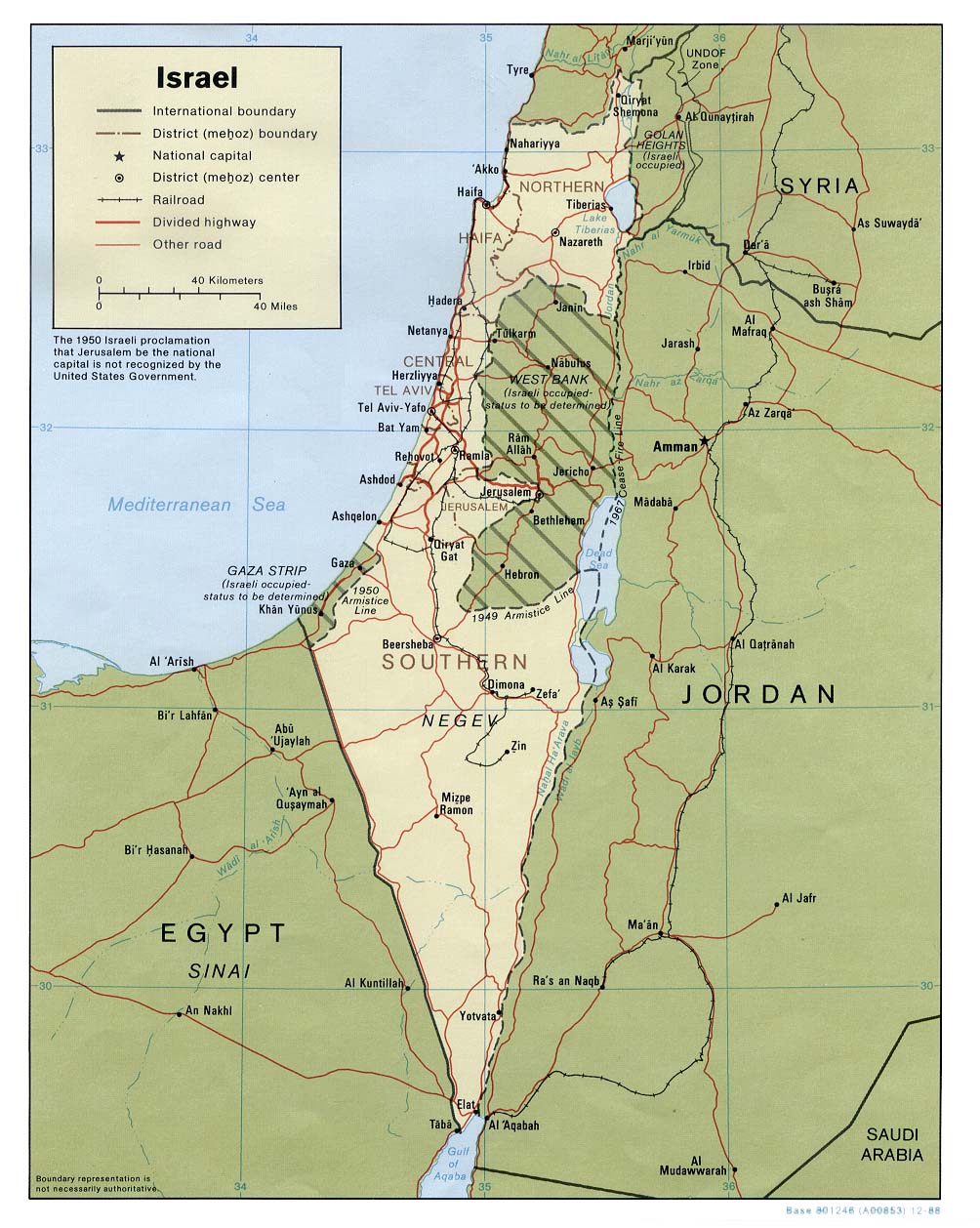
Supporters of the barrier argue that this is necessary to curtail Palestinian terrorism, and use the decreased number of suicide bombings, as a measure of success. Opponents often call it the Apartheid Wall, and contend that the barrier deviates into occupied Palestinian territory, and is merely an attempt by Israel to annex Palestinian land under the guise of security. In some places, it diverges more than 20 km to include Jewish settlements in the Palestinian West Bank on the Israeli side.
I didn’t know what to think or feel when I first saw the Wall. It kind of smacks you into silence. The massive, gray concrete slabs resemble giant domino blocks, only these ones you can't knock down. Menacing watch towers are staggered along the Wall. I looked up at the windows, and wondered if anyone was looking at me in return. And if they were, did they have their hands on a gun? It reminded me of something one might have seen during the Cold War in Russia or Eastern Europe.
All over the world, humans have been building walls for thousands of years. Indeed in our relationships with family, friends, and colleagues, we often build walls. So, maybe we shouldn’t be surprised that we continue to build fences instead of bridges. In some ways, it’s easier to put up a barrier than deal with conflict. A sad testament to the human condition, really.
The Wall may be a separation barrier, but it has also become a massive canvas for social and political expression. Scrawled across the bleak gray concrete are messages of all kind. Some of it art, some just simple, yet poignant messages, but all of it represents a solidarity of sorts.
I wrote down a handful of the messages. Some represent resolve, others a sense of helplessness, while others still, a sense of hope:
We will never give up
It’s not a fence, you stupid
Why is this grey piece of shit still here
Imprisonment is as irrevocable as death
Even Rome fell
Free the people now
When is change gona (sic) come
England loves you (honest)
Fear builds walls
Let the people dance, sing, hope
FORGIVE...it feels better
One day will change
A restaurant next to a portion of the Wall has tried to turn the miserable looking area into a positive, by renaming their restaurant the Wall Lounge, and posting their menu in large letters on the concrete across the street. Others, though, are confronted with it in a more direct way. i walked down one street and the Wall was little more than 20 feet from the front of people’s homes. Once they would have looked across to Jerusalem; now they are forced to look at 26 foot slabs of concrete.
Whenever I think of this Wall, I’m immediately taken to the 1987 speech that U.S. President Ronald Reagan made in front of Berlin’s Brandenburg Gate, in which he called the Berlin Wall a scar, and uttered what became the most famous words from that speech: “Mr. Gorbachev, tear down this wall!”
I hope that in my lifetime the wall separating Israel from Palestine, which only further divides people, will be torn down.


 Young boys near Zababdeh

 Walking through Wadi Auja


 Many great cities around the world are defined by their amazing skylines. Think Chicago, New York, San Francisco, Shanghai, and Hong Kong. Even Sydney and Paris have signature buildings that have given rise to these great places. While there have been a few positive developments, I often wish the citizenry and decision makers in Vancouver were bolder when it comes to taller buildings.
 I don't expect a lot from the cashiers at the supermarket. I'm not fussy about how they bag the groceries, as long as they don't squish the bread (in fact fewer bags the better). I don't care that they have to look up the PLU code for parsnips, parsley, or persimmons. And I surely don't expect them to know my name. So why then do some supermarkets insist on the cashiers thanking customers by name when they don't even know them. It's torturous for the poor clerk who struggles with the proper pronunciation, and it's torturous for the person who has to listen to their name being butchered.
 Honestly, and really isn't that what this is all about, the only corruption that we have knowingly engaged in was in South Korea. As foreigners working in Korea, we needed to obtain an Alien Registration Card. One day, the mysterious Mr. Park, whose job we never really knew and who just appeared from time to time, escorted Carrie and I, along with two other teachers, to the Department of Immigration. Housed in a non-descript , concrete building, we found a seat along a back wall. After a long wait we went individually to a counter to get fingerprinted and had our picture taken, so we could be registered as Aliens.


 Posts