
If you are interested in having a photo calendar or book produced, especially during the coming holidays (St. Nicholas Day, Hanukkah, Christmas, and Kwanzaa), then you might consider using the link below to purchase one through usharephoto, and in doing so support the Children's Organ Transplant Society.
I sit on the Board of this grassroots organization that for the past 10 years has provided much needed support for children (and their families) waiting for an organ transplant, and also those that have received this life-saving procedure.
By purchasing a photo book or calendar through this link, a significant portion of the cost will be redirected back to the Children's Organ Transplant Society to fund expanded programs, including sending children to summer camp, and helping alleviate some of the costs for families who need to purchase medical supplies and medications that are not covered by government programs.
http://www.usharephoto.com/Microsites/COTS/
Should you have any questions, please let me know @ whitemanwalking@gmail.com. And feel free to share this link with your family and friends.
Monday, November 29, 2010


Saturday, November 27, 2010
Learning about the world...one day at a time
 |
| Jack at one year...brushing up on his geography |
My sister used to poke fun at me for reading an atlas before going to bed when I was young. In fact, I still love looking through an atlas. So, it shouldn’t really be a surprise that Jack, my eldest son, who is five years old, shares that same curiosity of the world. I remember when he was just a little over one year old at Disneyland, and he was pouring over the Park map, as if ready to offer someone directions. For months afterward he would look at that same map before going to bed. More recently he’s taken to scrolling through Google Earth. And while he often zeroes in on one of the five Disneyland Parks throughout the world, he also takes delight in finding London’s Big Ben, or the Eiffel Tower, or the Amazon River.
His interest in the world has been fuelled in part by the places he’s already visited in his short life, including: Montreal, Quebec City, California, Hawaii, Fiji, and Australia.
 |
| Jack finds his way at Disneyland |
I remember once over dinner some time ago, Jack remarked with certainty, “I want to go to Chicago!” "Why do you want to go there," his mother asked? "Because I want to know what's there," he replied, sounding very grown up. He also often quips that he would like to visit Paris and New York City. And while he hasn’t yet been, I have little doubt that he will one day visit these iconic cities.
As parents, we have had the opportunity to travel, and so my wife and I don’t discourage his geographical inquisitiveness. In fact, we often end up folding and putting away the many maps that he has collected and keeps in a box.
Recently, I wondered how I could enhance his curiosity for the world, and at the same time provide a fun, learning experience. That’s how the big tin, which coincidentally is adorned with the flags of the Canadian Provinces, came to find a place in our kitchen.
In it, I put several pieces of paper with the names of countries, along with an image of their flag, and information about that country, such as the capital, language, currency, literacy rate, and landmark.

Each day, Jack excitedly reaches into the tin and pulls out one country and reads about that place. He now knows that the capital of Nepal is Kathmandu and the literacy rate in the Himalayan country is less than 50%. In contrast, he also knows that in Finland (and Norway) the literacy rate is 100%. I wanted to include the literacy rate of a country, because I felt it was important that Jack know that while he has access to knowledge, books, and an education, it isn’t so for many people around the world. In fact, when he learned that half the people in Nepal over the age of 15 can’t read or write his eyes grew big and he said, “That’s not good.”
The first day we introduced the big tin, we had to temper Jack’s enthusiasm, because he wanted to read about all the countries in the tin at once. Letting him choose one country a day has created some fun and excitement, as he looks forward to learning about the next one.
So far Jack has learned about familiar places, such as Canada, the United States, and from the movies, Madagascar, but he also now knows a little something about Turkey, Qatar, Hungary, Egypt, Bolivia, Kenya, India, and a host others.
Friday, November 19, 2010
Ferry fares not really out of line
 |
| BC Ferries' Spirit of British Columbia in Active Pass |
Why would B.C. Ferries buy space rinkside at Rogers Arena? They even have a huge ad under the clock. I wonder how much those cost? Last time I checked there was no other ferry competition in BC. Where does this ad money come from, our inflated ferry rates?
This letter, by Rudy Pospisil, was recently published in The Province newspaper.
Reminds of the conversations I used to have with my father, who retired as a Captain at BC Ferries after having worked there for 42 years. “Why does BC Ferries need a marketing department,” he would often pontificate. In his mind, the real work of the ferries was done on the ships, not in some distant office, and definitely not done by some marketing people. I’m not sure that he ever bought into it, but I always told him that those marketing people help drive passengers on to the ferries, and without them he would have fewer opportunities to transport people back and forth.
Sure enough there are very few options, apart from an airplane to travel between the many islands that dot the coast and the mainland of British Columbia. And some people will have no choice but to take a ferry. But BC Ferries doesn’t hold a monopoly on where people spend their leisure dollars. And with games being televised around the world, what a splendid opportunity to promote one of the world’s finest ferry systems in the world. Yes, BC Ferries needs marketing people just as they need Captains. Some may think one is more important than the other, but in the end, each is contributing to the same goal.
But back to Pospisil’s letter and his assertion that BC Ferries' rates are inflated. (I’m sure people would still find a way to complain even if the fare was free). I wonder if Pospisil realizes the cost of operating a fleet of 36 ships to 47 ports scattered hundreds of miles along the coast of BC? Does he realize that the cost of fuel has risen sharply in recent years? Does he know that on some routes the fare charged doesn’t even come close to cover operating costs, and yet the ferry company continues to provide this public service. Furthermore, does Pospisil know what comparable ferry fares are around the world?
Tell me if you think BC Ferries’ fares are inflated. (all fares have been converted to CDN Dollars)
BC Ferries
Vancouver - Vancouver Island
Sailing time: 95 minutes
Sailing time: 95 minutes
Passenger – $13.75
Car and passenger - $58.25
P&O Ferries
Dover – Calais
Sailing time: 90 minutes
Passenger - $30
Car and passenger - $40
Black Ball Ferry Co.
Port Angeles – Victoria
Sailing time: 90 minutes
Passenger - $15.50
Car and passenger - $55
Blue Star Ferries (Greece)
Naxos – Paros
Sailing time: 45 minutes
Passenger - $10
Car and passenger - $48
Inter Islander (New Zealand)
Wellington – Picton
Sailing time: 3 hours
Passenger - $51
Car and passenger - $164
Wightlink (UK)
Fishbourne – Portsmouth
Sailing time: 40 minutes
Passenger - $14
Car and passenger - $82
Wednesday, November 17, 2010
Japanese ingenuity at its best
Aside from odd television programming and karaoke, I have great admiration for the Japanese. Instant noodles, the Walkman (for those of a certain age, yes there were portable music players before the iPod) high speed trains, robots and toilets that come with remotes and play music are all part of Japanese ingenuity. Oh, and my car is Japanese.
And now the Japanese have created a series of vending machines that use facial recognition technology to recommend customers a beverage. No need to think. The machine will recognize if you are male or female, or of a certain age, and will then show images of recommended drinks based on your characteristics. The time of day and temperature will also determine which drinks are recommended. Apparently, the company has done extensive market research; hence, the machine may offer a woman in her 20s a slightly sweeter beverage, while an older man might have green tea as a recommendation.
My only question is would it recognize my preference for Coke over Pepsi if I wink or wiggle an ear?
And now the Japanese have created a series of vending machines that use facial recognition technology to recommend customers a beverage. No need to think. The machine will recognize if you are male or female, or of a certain age, and will then show images of recommended drinks based on your characteristics. The time of day and temperature will also determine which drinks are recommended. Apparently, the company has done extensive market research; hence, the machine may offer a woman in her 20s a slightly sweeter beverage, while an older man might have green tea as a recommendation.
My only question is would it recognize my preference for Coke over Pepsi if I wink or wiggle an ear?
Friday, November 12, 2010
How fortunate we are
Yesterday I took my five year old son to a Remembrance Day service at Vancouver's Victory Square. Thousands crowded around the cenotaph. Poems were read, songs sung, and a lone bugler silenced the mass with the stirring notes of The Last Post.
But the most poignant moment for me came when the first shot was fired from a large field gun a few blocks away on the harbour. The booming sound startled my son. "Daddy, what was that?" he asked with alarm, pulling himself close to me.
In that instant I imagined a young boy or girl holed up in the security of their home in London or Dresden some 70 years ago asking that same question, as bombs were exploding around them. I imagined the parents masking the worry on their faces, and telling their children that everything would be okay. Then I realized that even today, somewhere in the world, a child was probably clutching their mother or father in fear and asking what that unsettling sound was. A gun, perhaps. Or maybe a bomb.
With the sound of the 21-gun salute echoing throughout the city, my son and I walked to our car and drove away. How fortunate we are.
But the most poignant moment for me came when the first shot was fired from a large field gun a few blocks away on the harbour. The booming sound startled my son. "Daddy, what was that?" he asked with alarm, pulling himself close to me.
In that instant I imagined a young boy or girl holed up in the security of their home in London or Dresden some 70 years ago asking that same question, as bombs were exploding around them. I imagined the parents masking the worry on their faces, and telling their children that everything would be okay. Then I realized that even today, somewhere in the world, a child was probably clutching their mother or father in fear and asking what that unsettling sound was. A gun, perhaps. Or maybe a bomb.
With the sound of the 21-gun salute echoing throughout the city, my son and I walked to our car and drove away. How fortunate we are.
Wednesday, November 10, 2010
Remembering Vimy
Given that tomorrow is Remembrance Day (not Rememberance, as some people seem to think), I decided to dig out a piece from my archives (okay, really it was the bottom of a filing cabinet) that I wrote after visiting Vimy Ridge, almost to the day in 1993. The article was published in a student newspaper in 1996.
Remembering Vimy
For more information on the Vimy Ridge Memorial
http://www.vac-acc.gc.ca/remembers/sub.cfm?source=memorials/ww1mem/vimy
A poignant reminder of Remembrance Day is Terry Kelly's, A Pittance of Time
http://www.youtube.com/watch?v=2kX_3y3u5Uo&feature=related
Remembering Vimy
Before I visited the Canadian War Memorial at Vimy Ridge, in France, I didn’t know what to expect. My limited knowledge of Vimy came from what I read in books and watched on television. But after witnessing the wounds that were so callously inflicted upon the earth and scrolling my hands across the monument that stands as a testament to this tragedy, I have a new understanding of what Vimy Ridge means, an understanding that can only be gained by being there.
Growing up, I was told of the sacrifices made by my grandparents, great grandparents, and even by strangers. I learned of the tragedy that consumed the world in 1914 and again in 1939. And each November I wore a poppy.
Remembering was always difficult, though—my generation never experienced anything as horrific as a world war. Not even my parents could fully comprehend. Besides, how could I remember something if I was never there? I read of the atrocities that swept across Europe, but somehow it didn’t seem real. I watched the aging veterans march by on Remembrance Day, but they seemed more like grandfathers than soldiers.
Seventy-eight years ago, thousands upon thousands of Canadians, most of them younger than I am a today, gave their lives simply for the sake of human misfortune. Others, fortunate enough to survive, would have forever etched in their memories a brutal place where they lost their friends, their innocence, and most of all the simple joys we take for granted.
As I stood on the Ridge it was hard to imagine what went on seventy-nine years ago. The clouds hung low, and a cool mist was in the air, much like it must have been during the war. I tried to picture what it would have been like during the battle—the piercing sounds of artillery fire, the final words of a wounded soldier—but there was just a serene calmness. Beautiful trees and lush grasses have replaced the blood and tears.
For those who were never there, remembering is difficult, but compassion and understanding is the greatest gift we can give to those who courageously went to war. November is a special time to remember those who sacrificed their lives. Let us never forget, for when we begin to lose sight of the sacrifices given, another senseless war will once again consume the world. To those who so bravely answered the call — thanks.
~ Ken Donohue…1996
For more information on the Vimy Ridge Memorial
http://www.vac-acc.gc.ca/remembers/sub.cfm?source=memorials/ww1mem/vimy
A poignant reminder of Remembrance Day is Terry Kelly's, A Pittance of Time
http://www.youtube.com/watch?v=2kX_3y3u5Uo&feature=related
Friday, November 5, 2010
Isn't a superjumbo a hot dog?
As much as I dislike the look of the Airbus 380 (it's an ugly beast), I equally disdain the use of the word superjumbo when referring to the world's largest commercial airplane. I have a friend who has flown on the A380 and he spoke glowingly of the aircraft's passenger cabins. This may be so, but it lacks the grace and beautiful lines of the Boeing 747, previously the world's largest commercial aircraft.

I first saw the Airbus A380 in Hong Kong, while the aircraft was performing a number of proving flights. And earlier this year while in Toronto I saw an Emirates A380 preparing for its 13-hour non stop flight to Dubai. It was an eye-catcher to be sure, as people were fumbling for their cameras, but it still did little for me.
But back to unoriginal monikers. Before the launch of the Boeing 747 in the late 1960s, the term "jumbo jet" (a term I regard on par with superjumbo) had been coined by the media to describe a a new class of wide bodied aircraft being developed. To their credit, Boeing apparently tried to discourage the media and public from using the term for the 747. Unfortunately, their efforts were in vain, as the Boeing 747 and "jumbo jet" became synonymous.
So, if it's necessary to provide a moniker for the Airbus A380, and personally I don't see the need, why then have we chosen the most unoriginal, superjumbo? Because the A380 is bigger than the 747, therefore we shall call it the superjumbo?. Is that the best we could come up with? Reminds me how every little political scandal now ends with the word "gate", because of Watergate.
And how is it that two adjectives have now become a noun. And why does the media feel it necessary to populate every article on the A380 with the word superjumbo?
You may have heard that a Qantas Airbus A380 made an emergency landing shortly after taking off from Singapore the other day when an explosion in one of its engines caused that engine to fail. While the damage to the engine looked dramatic, it would probably have been a fairly routine landing, as its three other engines were apparently operating fine.
In one article on the incident, a reporter unnecessarily used the word superjumbo twice in the first paragraph:
Australia's Qantas Airways grounded all its Airbus A380 superjumbos Thursday after an engine failure forced one of the superjumbos to make an emergency landing in Singapore with more than 450 people on board.
And here I thought a superjumbo was a hot dog sold on the streets of Manhattan.

I first saw the Airbus A380 in Hong Kong, while the aircraft was performing a number of proving flights. And earlier this year while in Toronto I saw an Emirates A380 preparing for its 13-hour non stop flight to Dubai. It was an eye-catcher to be sure, as people were fumbling for their cameras, but it still did little for me.
But back to unoriginal monikers. Before the launch of the Boeing 747 in the late 1960s, the term "jumbo jet" (a term I regard on par with superjumbo) had been coined by the media to describe a a new class of wide bodied aircraft being developed. To their credit, Boeing apparently tried to discourage the media and public from using the term for the 747. Unfortunately, their efforts were in vain, as the Boeing 747 and "jumbo jet" became synonymous.
 |
| The Boeing 747, a beautiful looking airplane. Photo by sirsteveincairns.smugmug.com |
So, if it's necessary to provide a moniker for the Airbus A380, and personally I don't see the need, why then have we chosen the most unoriginal, superjumbo? Because the A380 is bigger than the 747, therefore we shall call it the superjumbo?. Is that the best we could come up with? Reminds me how every little political scandal now ends with the word "gate", because of Watergate.
And how is it that two adjectives have now become a noun. And why does the media feel it necessary to populate every article on the A380 with the word superjumbo?
You may have heard that a Qantas Airbus A380 made an emergency landing shortly after taking off from Singapore the other day when an explosion in one of its engines caused that engine to fail. While the damage to the engine looked dramatic, it would probably have been a fairly routine landing, as its three other engines were apparently operating fine.
In one article on the incident, a reporter unnecessarily used the word superjumbo twice in the first paragraph:
Australia's Qantas Airways grounded all its Airbus A380 superjumbos Thursday after an engine failure forced one of the superjumbos to make an emergency landing in Singapore with more than 450 people on board.
And here I thought a superjumbo was a hot dog sold on the streets of Manhattan.
Monday, November 1, 2010
Who's taxing who?
It's long been argued that airlines and airports in Canada (especially ones near the U.S. border) are often competitively disadvantaged when compared to their U.S. counterparts, because of the higher taxes and fees charged to air travellers in Canada.
On a recent visit to the Bellingham Airport, I couldn't help but notice that the majority of vehicles in the parking lot were from British Columbia--Canadians crossing the border for a good deal. In fact, according to the airport, 60% of the passengers flying out of Bellingham are Canadian.
Alaska Airlines does not break the various taxes down when making a booking, but at $21.40 it's a modest amount.
Scenario 2 - Vancouver to Honolulu
The light blue represents the Canadian taxes/fees and the dark blue are those collected by U.S agencies. Surprising to many, perhaps, but you'll notice that almost half--$52.54--are U.S. taxes and fees.
So, what does it tell us? Well, it shows that the United States isn't as tax friendly as they are made out to be, and a family of four flying to HNL would save more than $600 by flying out of Bellingham. Explains why there are so many cars from Canada parked at BLI.
On a recent visit to the Bellingham Airport, I couldn't help but notice that the majority of vehicles in the parking lot were from British Columbia--Canadians crossing the border for a good deal. In fact, according to the airport, 60% of the passengers flying out of Bellingham are Canadian.
There are a few reasons for this, not withstanding that Bellingham Airport, or BLI as it is known by its three letter code, is just 32 km (20 miles) from the Canada/U.S. border. First, BLI is served by low-cost carrier Allegiant, which operates to seven leisure destinations from that airport, and often offers exceptional fares.
The second point is that the taxes and fees charged on a ticket from Bellingham are much lower than on similar flights from Vancouver International. This got me curious as to the difference in these taxes and fees, and who collects what?
Respective governments in Canada often take the brunt of criticism from passengers, and those in the industry, who have long complained about high taxes and fees on airline tickets. But after comparing fares from both Bellingham and Vancouver, I was somewhat surprised to learn that Uncle Sam has his hands in your pockets, more than most people are probably aware.
So, here's what I did. I chose Honolulu as a destination, because, well...who wouldn't want to go to Hawaii? And also because Alaska Airlines will begin daily service from Bellingham in January.
 |
| Honolulu's famed Waikiki Beach, with Diamond Head bottom right |
Sames dates were chosen for each example. For this example I chose the same dates in April.
Scenario 1 - Bellingham - Honolulu
Alaska Airlines
$426.20 - fare
$21.40 - taxes/fees
$447.60 - total
Alaska Airlines does not break the various taxes down when making a booking, but at $21.40 it's a modest amount.
Scenario 2 - Vancouver to Honolulu
WestJet (Air Canada's fare was $15 more)
$497 - fare
$110.25 - taxes/fees
$607.25 - total
Here is a breakdown of the $110.25 in taxes and fees charged on a ticket departing Vancouver.
$15 - NAV Canada surcharge (funds air navigation system)
$15 - Vancouver airport improvement fee
$25.91 - Canadian Air Travellers Security Fee
$1.80 - Canadian Sales Tax
$4.62 - U.S. Passenger Facility Charge
$33.04 - U.S. Transport Tax
$5.13 - U.S. Agriculture Fee
$2.57 - September 11 Security Fee
$7.18 - U.S. Immigration Fee
$110.25 - Total
The light blue represents the Canadian taxes/fees and the dark blue are those collected by U.S agencies. Surprising to many, perhaps, but you'll notice that almost half--$52.54--are U.S. taxes and fees.
So, what does it tell us? Well, it shows that the United States isn't as tax friendly as they are made out to be, and a family of four flying to HNL would save more than $600 by flying out of Bellingham. Explains why there are so many cars from Canada parked at BLI.
Friday, October 22, 2010
Cents and nonsense
So I've said it before, and I'll say it again...it's time for the Canadian Government to stop minting the one cent coin.
It's a terrible waste for something that has virtually no value. People throw the darn things away or squirrel them away in jars and out of circulation, forcing the government to produce more cents. It doesn't make any sense. Why do we continue to allow this to happen? I was heartened by a nationwide poll a few months back that suggested almost 60% of Canadians would be in favour of scrapping the Penny. I have no idea what the other 40% are thinking, but the majority of Canadians are thinking with their heads.
I haven't heard a good argument for keeping the one cent coin. In fact, the only thing I ever hear is that merchants will round the price up if the Penny is discontinued. Really? Is that it? We're going to continue to waste money and resources, because someone is afraid they might have to pay a couple more cents for their cup of coffee, which they are already paying $3 or $4 for anyway. Big deal, I say. Even if the price did get rounded, the sky isn't going to fall, as other more progressive and forward thinking countries have already done away with their low denomination coins.
When I saw this poll in the news, I thought I would ask the Federal Government what their position was on this issue (I asked the candidates in my riding during the last election, and none bothered to respond, even the Green Party candidate whose biggest accomplishments were that he grew up in the riding, learned to ride his bike in the riding, and went on his first date in the riding, I digress).
I sent the following email to the Department of Finance on August 17th:
Hello,
For some time I have wondered why Canada continues to produce the one cent coin. Today, they are of little value, which is witnessed as people more often throw them away, or toss them in jars, putting them out of circulation. Public opinion polls suggest that the majority of Canadians want to get rid of the one cent coin, yet the government seemingly doesn't have an interest in stopping production of the coin.
I would be interested in knowing why the government continues to produce the one cent coin, and if there is a plan to stop production in the near future?
I look forward to hearing from someone.
Kind regards,
Ken Donohue
The other day, more than two months after sending my message, I received the most patronizing, meaningless, absurd response from James Flaherty, the Minister of Finance (okay, I know he knew nothing of my message, but he signed the inane letter). He didn't even answer my questions.

Thank you for your correspondence of August 17, 2010 regarding Canadian currency.
It's a terrible waste for something that has virtually no value. People throw the darn things away or squirrel them away in jars and out of circulation, forcing the government to produce more cents. It doesn't make any sense. Why do we continue to allow this to happen? I was heartened by a nationwide poll a few months back that suggested almost 60% of Canadians would be in favour of scrapping the Penny. I have no idea what the other 40% are thinking, but the majority of Canadians are thinking with their heads.
I haven't heard a good argument for keeping the one cent coin. In fact, the only thing I ever hear is that merchants will round the price up if the Penny is discontinued. Really? Is that it? We're going to continue to waste money and resources, because someone is afraid they might have to pay a couple more cents for their cup of coffee, which they are already paying $3 or $4 for anyway. Big deal, I say. Even if the price did get rounded, the sky isn't going to fall, as other more progressive and forward thinking countries have already done away with their low denomination coins.
When I saw this poll in the news, I thought I would ask the Federal Government what their position was on this issue (I asked the candidates in my riding during the last election, and none bothered to respond, even the Green Party candidate whose biggest accomplishments were that he grew up in the riding, learned to ride his bike in the riding, and went on his first date in the riding, I digress).
I sent the following email to the Department of Finance on August 17th:
Hello,
For some time I have wondered why Canada continues to produce the one cent coin. Today, they are of little value, which is witnessed as people more often throw them away, or toss them in jars, putting them out of circulation. Public opinion polls suggest that the majority of Canadians want to get rid of the one cent coin, yet the government seemingly doesn't have an interest in stopping production of the coin.
I would be interested in knowing why the government continues to produce the one cent coin, and if there is a plan to stop production in the near future?
I look forward to hearing from someone.
Kind regards,
Ken Donohue
The other day, more than two months after sending my message, I received the most patronizing, meaningless, absurd response from James Flaherty, the Minister of Finance (okay, I know he knew nothing of my message, but he signed the inane letter). He didn't even answer my questions.

Here is the text of the letter:
Dear Mr. Donohue:
Thank you for your correspondence of August 17, 2010 regarding Canadian currency.
The Government of Canada's objective is to serve the coinage transaction needs of Canadians. In collaboration with the Royal Canadian Mint and the Bank of Canada, the Department of Finance Canada works to ensure that our economy has a sufficient quantity and appropriate denominations of coins and bank notes to meet the financial needs of Canadians. We assess the use of currency denominations by Canadians regularly to determine how best to serve their needs.
Thank you for communicating your concerns.
Sincerely,
James M. Flaherty
How much did they pay someone to write that drivel? I don't know what's worse, the fact it took two months to get a response or the nonsensical letter itself.
My two questions are still outstanding -- why does the Government continue to produce the one cent coin, and is there is a plan to stop production in the near future?
I wonder if the lackey that wrote this letter has any idea that the Canadian Senate's National Finance Committee has been holding hearings on this issue, since last Spring. (yes, apparently they actually do something). I'm not sure why that's necessary, but if they must.
And a week or two before I received the missive from Mr. Flaherty's office, the head of New Zealand’s Reserve Bank currency department told the hearing about his country's move to get rid of their one and two cent coins in 1989 (yes, that's more than two decades ago)
“The one- and two-cent coins had lost their value and no longer had any effective purchasing power, and as in Canada, the coins had become more costly to produce than they were worth. So it was a relatively straight-forward exercise”
No kidding! Of course it's straight-forward. It was reported that the Committee is expected to report its findings to Mr. Flaherty in the coming months. So, why wasn't that information included in the response from the Minister's office?
It may seem like a small issue (though it can't be if a Senate committee is spending months studying this), but to me it's a small win. It just makes sense. The majority of Canadians see it that way, as have other countries.
Friday, October 1, 2010
Finding promise in Bolivia's largest city
 |
| City Hall in Plaza 24 de Septiembre |
I had only been in Santa Cruz, Bolivia for less than 12 hours when someone asked what I thought of the city. I hate these questions, because invariably I’m forced to lie. I find that either the place is a real dump (though I can usually see some beauty amidst even the crappiest of places), or I haven’t had enough time to get a feel for the place. In the case of Santa Cruz it was the latter.
“It’s good,” I offered, not telling him that five of those 12 hours was spent sleeping off two days of fatigue. Really, at that point my impression of the city was gleaned from looking out the windows of a taxi from the airport to my hotel and another taxi to the offices of AeroSur.
I’ve long thought that Bolivia was one of the more random countries in South America. Not quite as obscure as those three countries on the top right of the continent that no one remembers. See, you’re scratching your head trying to figure them out. Let me save you some time looking it up – Suriname, Guyana, and French Guiana.
Bolivia is one of only two landlocked countries in South America—the other being the equally random country of Paraguay. Bolivia actually lost its coastline to Chile in the War of the Pacific, which lasted for five years, ending in 1884.
It is one of the poorest and least developed countries in South America, and is geographically diverse—from the Andes to the Altiplano, or high plains, to the eastern lowlands, much of it Amazonian rainforest. At more than 13,000 feet, it boasts the world’s highest capital [La Paz], and is home to the world’s largest salt flat, and shares with neighbouring Peru, Lake Titicaca, the world’s highest navigable lake.
 |
| Christ...looking down Avenue Monsenor Rivero |
If indeed you have an image of Bolivia, then it probably includes an indigenous woman wearing a bowler hat with a colourful blanket draped over her shoulders. But as diverse as the high Andean peaks are to the sweltering jungles of the east, so too are Bolivia’s cities. In many respects, Santa Cruz de la Sierra [it’s official name], the country’s largest city is world’s away from the capital, La Paz. Santa Cruz is relatively new. Just a few decades ago, the city’s population was just over 100,000. Now it is more than 1.5 million and the source of much internal migration, as the poor from other parts of Bolivia move here for a better life. Santa Cruz is the business centre of the country and is more prosperous—evidenced by the number of luxury car dealerships and international brand stores.
Some, like one person I was talking to, feel that the city has grown too quickly, and that the infrastructure hasn’t always kept pace. It’s a city that seems a little worn around the edges, and yet turn a corner and you’ll see a modern and hip side. Stylish fashion, coffee shops that spill out onto the sidewalks, and business people with big ideas.
 |
| A bank in Santa Cruz...I didn't know Jesus had been in the banking business |
While the temperature in Santa Cruz is usually in the 30s, for the past two days, cool winds from southern Argentina, called surazos, common during the winter months have blown in and lowered the temperature by more than 10 degrees.
Many of the city’s streets have been covered with hexagon-shaped paving stones, which when put together have the look of large honeycombs. While driving over the stones, which invariably are uneven, makes for a bumpy ride, one is amazed when you think that each stone was laid by hand. Apparently, this labour-intensive work was initiated to create jobs. I can see how it would accomplish that.
To the outsider, the streets seem calmly chaotic. Is there such a thing as orderly chaos? Traffic doesn’t move all that fast, but apart from the ring roads, there are few lights or stop signs, yet it all seems to work. At the city’s large roundabouts it is as if the cars are an army ants, veering from side to side finding an opening, as they fight their way back to the colony.
Crossing the street can take some patience, as the few cross walks that exist are apparently considered street art, because cars don’t stop for pedestrians. A few times I caught myself standing on the corner for some time waiting for a break in the traffic that never came. It was then that I took the cue of a local and followed them across the street finding holes in the string of cars.
I made my way to Plaza 24 de Septiembre, the centre of Santa Cruz. The square is ringed by the historic town hall, Basillica de San Lorenzo, some tourist shops and an Irish pub. I made like the locals and found an empty bench.
 |
| Basillica de San Lorenzo |
Several shoe shiners had chairs set up in the square. When not shining shoes, they were selling small bags of corn for people to feed the pigeons. Looking at my grubby shoes, I decided they needed a shine, so I climbed up on the green chair, and was handed a newspaper. Since it was in Spanish I put it aside and watched the guy ply his trade. A shoe shine costs 3 Bolivianos, or 45 cents. I gave him 10 Bolivianos and walked back to my hotel, dodging the traffic and trying not to scuff my shiny shoes.


Now back to that first question about my thoughts on Santa Cruz. The city itself has little to offer the visitor [which I knew before I arrived], though the cakes in the coffee shops are delicious. Bolivia’s stark beauty lies elsewhere. For Bolivians, Santa Cruz offers the chance for a better future. And if that’s the case, then surely it must be a good place.
Tuesday, September 28, 2010
I left Hollywood Beach and turned south towards Miami leisurely driving through the string of beach towns. Beautiful apartment towers lined the beaches, while million dollar homes and million dollar boats lined the canal on the opposite side. Finally, I reached Miami's famed South Beach, where its pastel hued art-deco buildings are filled with apartments and quaint hotels, trendy restaurants and funky coffee shops.

After a quick walk through the area, I hopped back into the car and drove across the Venetian Causeway, so named because of the old, white bridges that span the many man-made islands in Biscayne Bay. For added drama, two shafts of lightning on either side of me shot down and the ominous roar of thunder shouted across the bay. Then, the sky that had looked bruised and beaten for much of the day exacted its revenge by lashing out and unleashing a savage rain storm.
Thinking it must be a sign to leave, I make my way to the airport.
 |
| A brooding Miami sky |
There's lots to like about the United States, but the fact you can rent a car for $17 a day (and that includes all the insidious fees) is one of them.
With a 15 hour layover in Miami I wasn't sure what I was going to do with my bags. Schlepping them through the city didn't seem overly convenient. Getting a hotel was too expensive. So, renting a car seemed like a good option. I could store my bags in the trunk, and wheels would give me the opportunity to explore.
So, bleary eyed from the overnight flight, I took a shuttle to the car rental centre, hopped in a little white Kia Rio and drove east toward the beaches. I scanned the radio stations and found most were in Spanish. Not surprising, I suppose, when I later learned that more than two-thirds of the people in Miami speak Spanish as a first language. Just 25% claim the same for English.
I followed Highway 1 north toward Fort Lauderdale, passing through Golden Beach, where the money in this small community oozed from the beachfront mansions to the boulevard of stately palm trees that looked as if they were manicured daily. Residents seemed cloistered in their grand homes behind large walls and fancy gates.
I stopped at Hollywood Beach and walked across the powdery, gray sand. The sky looked bruised, as clouds coloured deep purple and black brooded in the background. The sun struggled to be seen, while the waves crashed onto the beach. I laid in the sand, closed my eyes, and let the warm water wash over me.
Except for the lifeguard and the odd jogger who passed by, I was alone at the beach.
 |
| Hollywood Beach, between Fort Lauderdale and Miami |
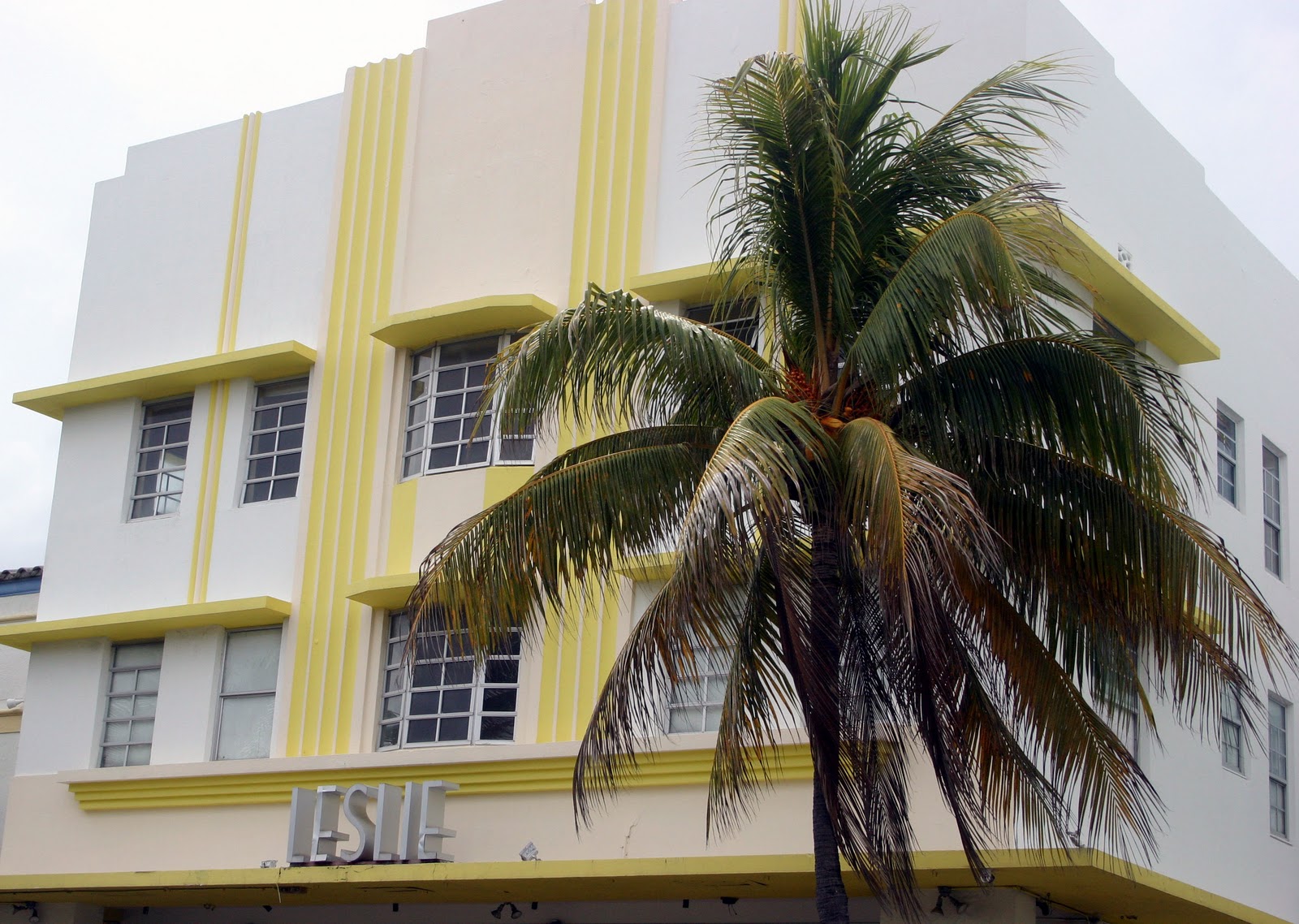
 |
| The pastel colours of South Beach |
After a quick walk through the area, I hopped back into the car and drove across the Venetian Causeway, so named because of the old, white bridges that span the many man-made islands in Biscayne Bay. For added drama, two shafts of lightning on either side of me shot down and the ominous roar of thunder shouted across the bay. Then, the sky that had looked bruised and beaten for much of the day exacted its revenge by lashing out and unleashing a savage rain storm.
Thinking it must be a sign to leave, I make my way to the airport.
Monday, September 27, 2010
Sleepless from Seattle

It's nine-thirty at night, and I'm in Seattle waiting for an overnight flight to Miami. I can't sleep on airplanes! I don't know if it's the seat, the noise, the proximity of the person next to me,or maybe some psychological issues of wanting to be in control (lest I'm seen drooling in public). Maybe it's the thought of sleeping with 130 other people.
I have a friend whose super power is that he can sleep anywhere - I'm sure he could even sleep on a 3rd class train in India. Even my father-in-law can fall asleep sitting up on a chair or sofa. I wasn't bestowed with such powers.
I remember once on an overnight flight from Honolulu to Vancouver. It was an old Canadian Airlines DC-10, and the in-flight entertainment didn't work. This was only a problem for me and the guy sitting across the aisle, because everyone else (including my wife) was sleeping. We just looked at each other knowing that we wouldn't be alone in our suffering. I don't know if one can read too much into the fact that a couple of hours into the flight those enjoying a restful flight had been shaken awake by bad turbulence. If we all can't sleep, then no one will.
Another time my wife and I were on an overnight bus in Australia and I had taken a Gravol, or a reasonable facsimile, and just as I was feeling groggy and my eyes heavy, the driver said he was stopping for a rest, and we had to exit the bus. I tried to stay awake in snack shop in a brightly lit gas station in the middle of an Australian nowhere, before climbing back on the bus and trying to sleep.
At 2,724 miles, the six-and-a-half hour flight from Seattle to Miami is the longest non-stop flight in the continental United States. And for me, no doubt the longest sleepless night as well. And if that wasn't bad enough, I will be in Miami for about 15 hours before boarding another overnight flight to Santa Cruz, Bolivia.
When I went to bed last night, I thought about how it would be three days until I would again be able to fall asleep in a bed.
A shame really that super powers can't be bought or traded. Maybe I will just have to find myself a palm tree to rest against on Miami Beach.
Thursday, September 23, 2010
Fifteen bucks to Mexico...sort of

What's the cheapest you've ever paid for a flight somewhere? I once paid about $40 (taxes and fees, if there were any, included) for a 90 minute flight on Iran Air, from the southern Iranian city of Shiraz to Tehran. An added bonus was getting to fly in an old Soviet-built Tupolev 154, which shook something terrible on takeoff.
I also bought a ticket for $39 for a flight from Seattle to San Francisco. The total cost of that return trip was $110. And a year or so ago, I snapped up tickets for the family to fly nonstop on Air Canada from Vancouver for Maui. I felt bad (okay not really) only paying Air Canada $410, taxes included, for the return flight.
Through a complicated online booking error, a friend of mine and her family (and several friends) booked a flight from Vancouver to Cairo for $350 (taxes and fees included). For those like my father, who would rather sail across the ocean rather than step into an airplane, the routing -- Vancouver-Toronto-Rome-Cairo-Rome-New York-Los Angeles-Vancouver-- may not have suited you, but for $350 I would have offered to walk the aisles clearing away meal trays.
Now what does all this have to do with the title of the post? Well, if you've noticed the flight deals in the newspaper recently you might have seen that you can fly to Mexico from Vancouver for $15. Of course, you'll have to leave on September 27 and return a week later. Oh, and you'll need to add $290 in taxes and fees. But for $305 you can find yourself on a beach in Mexico.
So, where does one find cheap fares? Sometimes it's luck, like the $400 round trip fare from Los Angeles to Sydney I once stumbled on just hours after the folks in Australia woke up from a night's sleep and discovered the error. But often it's take some poking around the Internet. And before you jump on that cheap fare, make sure you've added in the extras -- like fees for checked baggage, advanced seat selection, and for those with birthdays that fall on Wednesdays.
A couple of useful sights I have used.
Click on Airfare search and plug in some destinations. You can even search for a month period to find the best deal. And while you can't book directly from this site, it will give you the fare breakdown, which you can then use on a booking site or the airline's website.
www.flyertalk.com/forum/
You will find a lot of travel related information on this site. If you're looking for cheap airfares, then click on the Mileage Run Deals. Many of these deals are posted for people wanting to maximize the number of miles in their airline loyalty program, so you'll read about people who'll fly from San Francisco to Australia, only to spend a couple of hours in the airport, before reboarding the same aircraft back to the U.S.
Kayak is another useful tool for sourcing out good fares and prices on flights, hotels, and car rentals.
And remember, if you find a good deal, send me a postcard (do people still send postcards?).
Sunday, September 12, 2010
Sometimes we can't taste success on the first try

Like it was for the 4,000 other participants, it was the unique challenge of cycling 120km from Vancouver to Whistler that first attracted me to the GranFondo Whistler. I’ve driven the Sea to Sky Highway countless times, but to do it on a bicycle would be an entirely different experience. And so for the past five months I’ve excitedly been waiting for the day of the event. That it would end prematurely on a stretcher in the Medics tent was not how I imagined it to unfold, but more on that later.
As I mentioned in a previous post I had never been one of those real cyclists, clad in Lycra, but over the past four months I followed a training program that would make it easy to climb the hills and cover the distance to Whistler. Physically I was feeling great. I had lost a few pounds and was in better shape than I had been in years. I felt a great sense of accomplishment about 6 weeks ago, when I completed a 170km ride in Washington. Sure my legs felt like they had been hit by a truck when I finished, but considering I had been pedalling for more than seven hours, it was to be expected.
But soon after that ride, I would learn that my iliotibial band (a tough group of fibers that runs along the outside of the thigh; connecting the gluteal muscles and the tensor fascia lata muscle to the tibia, just below the knee) had become irritated, causing pain and discomfort in the knee.
I hoped that with rest, visits to the physiotherapist, and exercises specifically designed to strengthen the muscles in my legs and butt, I would be able to ride the GranFondo.
The day couldn’t have begun any better, as I joined the more than 4,000 cyclists crowding the start on Georgia Street, with the sun rising behind us. Soon I was rolling through the Stanley Park causeway and onto the Lion’s Gate Bridge. I admired the stunning view, while chatting with some other cyclists.
My legs felt great climbing Taylor Way in West Vancouver, and I was pleased with my time, when I hit 20 km, near Horseshoe Bay, in a little less than an hour. As I snaked along the Sea to Sky Highway I took care of my legs by resting them and not pedalling down steep hills. I nursed my left knee by pushing harder with my right leg--a strategy that I would later learn may work on a short ride, but would not stand up on a long one.
As I rounded a corner at Furry Creek, the first large hill rose up like a giant towering in front of me, as if daring to challenge its might. On the side of the road a group of supporters cheered on riders. Two women held a sign with a Lululemon logo on it that read, Do one thing a day that scares you. I overheard one cyclist say, “It doesn’t scare me... it just hurts.”
I was buoyed by the halfway sign, near Squamish and felt that despite some discomfort in my knees I was going to make it. After downing some pizza and pasta at the Squamish rest stop, I continued on and felt confident tackling what many would consider the most challenging part of the ride, a continuous climb that goes on for more than 7 km, and rises more than 1,000 feet.
“What a damn hill,” I heard a woman next to me mutter, as a line of cyclists, looking like a group of mountain climbers scaling a peak, pushed higher. Further on, I said to that same woman, “Are we there yet?” She replied that the hill had to end sometime.
I got off my bike at the fourth aid station, and I could feel that the ride was taking a toll on my knees. But after a quick rest, I set off again, and with just 30 km to go, I thought I could eke it out to the finish. I even imagined sending an, I DID IT text message to two of my friends and former colleagues, who are always keenly interested and supportive of my worldly exploits. But in the end I would never send that message.
As I soldiered on, the pain in my knees became sharp, and I winced each time my legs struggled to push down on the pedals. I knew a rest stop was only about 5km away, and I thought that maybe, just maybe if I could make it there, I might be able to get to Whistler.
But as I passed a sign on the highway marking 100km, the pain was excruciating and I could no longer will my legs to push anymore. I climbed off my bike, sat on a concrete barrier by the side of the road, and called my wife, who was waiting for me in Whistler.
“I can’t do it,” I said to her sounding defeated. “My legs won’t go anymore.” I asked her to come and pick me up. But just then two motorcyclists doing first aid duty stopped, and when I told them I couldn’t go any further, they called for someone to pick me and my bike up.
I stood on the side of the road, and as other cyclists passed by me I thought about success and failure. And while I was disappointed that I didn’t reach my goal, I tried to console myself with the fact that I gave it everything I had. And I reminded myself that sometimes we don't always taste success on the first try.
It was more than an hour later before I would arrive in Whistler, near the finish line in a small bus. I tried to stand to get off the bus, but I couldn’t. I tried again, but fell back into the seat. My legs had seized up and I couldn’t walk. Someone came to the bus and said they would get a wheelchair and a doctor. I was helped off the bus, and wheeled to a stretcher in the Medics tent, where they worked on my legs until they would move again. In great pain, I got into our car and my wife drove to our hotel. It’s not how I thought it would all turn out.
If my body will allow I’ll ride again next year, and try and slay this beast.
But soon after that ride, I would learn that my iliotibial band (a tough group of fibers that runs along the outside of the thigh; connecting the gluteal muscles and the tensor fascia lata muscle to the tibia, just below the knee) had become irritated, causing pain and discomfort in the knee.
I hoped that with rest, visits to the physiotherapist, and exercises specifically designed to strengthen the muscles in my legs and butt, I would be able to ride the GranFondo.
The day couldn’t have begun any better, as I joined the more than 4,000 cyclists crowding the start on Georgia Street, with the sun rising behind us. Soon I was rolling through the Stanley Park causeway and onto the Lion’s Gate Bridge. I admired the stunning view, while chatting with some other cyclists.
My legs felt great climbing Taylor Way in West Vancouver, and I was pleased with my time, when I hit 20 km, near Horseshoe Bay, in a little less than an hour. As I snaked along the Sea to Sky Highway I took care of my legs by resting them and not pedalling down steep hills. I nursed my left knee by pushing harder with my right leg--a strategy that I would later learn may work on a short ride, but would not stand up on a long one.
As I rounded a corner at Furry Creek, the first large hill rose up like a giant towering in front of me, as if daring to challenge its might. On the side of the road a group of supporters cheered on riders. Two women held a sign with a Lululemon logo on it that read, Do one thing a day that scares you. I overheard one cyclist say, “It doesn’t scare me... it just hurts.”
I was buoyed by the halfway sign, near Squamish and felt that despite some discomfort in my knees I was going to make it. After downing some pizza and pasta at the Squamish rest stop, I continued on and felt confident tackling what many would consider the most challenging part of the ride, a continuous climb that goes on for more than 7 km, and rises more than 1,000 feet.
“What a damn hill,” I heard a woman next to me mutter, as a line of cyclists, looking like a group of mountain climbers scaling a peak, pushed higher. Further on, I said to that same woman, “Are we there yet?” She replied that the hill had to end sometime.
I got off my bike at the fourth aid station, and I could feel that the ride was taking a toll on my knees. But after a quick rest, I set off again, and with just 30 km to go, I thought I could eke it out to the finish. I even imagined sending an, I DID IT text message to two of my friends and former colleagues, who are always keenly interested and supportive of my worldly exploits. But in the end I would never send that message.
As I soldiered on, the pain in my knees became sharp, and I winced each time my legs struggled to push down on the pedals. I knew a rest stop was only about 5km away, and I thought that maybe, just maybe if I could make it there, I might be able to get to Whistler.
But as I passed a sign on the highway marking 100km, the pain was excruciating and I could no longer will my legs to push anymore. I climbed off my bike, sat on a concrete barrier by the side of the road, and called my wife, who was waiting for me in Whistler.
“I can’t do it,” I said to her sounding defeated. “My legs won’t go anymore.” I asked her to come and pick me up. But just then two motorcyclists doing first aid duty stopped, and when I told them I couldn’t go any further, they called for someone to pick me and my bike up.
I stood on the side of the road, and as other cyclists passed by me I thought about success and failure. And while I was disappointed that I didn’t reach my goal, I tried to console myself with the fact that I gave it everything I had. And I reminded myself that sometimes we don't always taste success on the first try.
It was more than an hour later before I would arrive in Whistler, near the finish line in a small bus. I tried to stand to get off the bus, but I couldn’t. I tried again, but fell back into the seat. My legs had seized up and I couldn’t walk. Someone came to the bus and said they would get a wheelchair and a doctor. I was helped off the bus, and wheeled to a stretcher in the Medics tent, where they worked on my legs until they would move again. In great pain, I got into our car and my wife drove to our hotel. It’s not how I thought it would all turn out.
If my body will allow I’ll ride again next year, and try and slay this beast.
Wednesday, August 25, 2010
Colours of the World
I like airports. Once...okay, now that I think about it, it was twice --my wife and I needed to use a toilet, and since we were near an airport, we decided to drive there to use the facilities.


Others are iconic, like QANTAS and Aer Lingus and Swiss -- unmistakable in their origins.


But I like airports for more than just their washrooms. There is nothing like the feel of an airport. The excited anticipation felt by those flying to destinations near and far. And equally so, the anticipation of meeting someone at the airport. The opening and closing scenes in the movie, Love Actually, captures the essence of this spirit perfectly.
I love airports with large destination boards that read like pages from an atlas...Tokyo, Hong Kong, Shanghai, London, Paris, Sydney, Istanbul, Cairo, New York, Buenos Aires. Sometimes I'm not familiar with a destination, like when I was in Paris, and I saw a flight leaving for Douala. I later learned that it is in Cameroon, in western Africa.
There is nothing more graceful than watching a Boeing 747 on approach to an airport. Equally impressive is watching the same airplane weighed down with passengers, fuel, and cargo, lumbering down the runway and seemingly thumbing its nose at gravity and climbing into the sky. Or even catching sight of a nimble Boeing 737 that rockets off the runway.
But one of the best things I like about airports is looking at the colourful liveries (that's the paint scheme) from airlines around the world. In fact, once you get to know a few, you'll be able to spot them in the air. While white is a common base colour, each livery is unique.
There is nothing more graceful than watching a Boeing 747 on approach to an airport. Equally impressive is watching the same airplane weighed down with passengers, fuel, and cargo, lumbering down the runway and seemingly thumbing its nose at gravity and climbing into the sky. Or even catching sight of a nimble Boeing 737 that rockets off the runway.
But one of the best things I like about airports is looking at the colourful liveries (that's the paint scheme) from airlines around the world. In fact, once you get to know a few, you'll be able to spot them in the air. While white is a common base colour, each livery is unique.
Many airlines feature birds, symbolizing flight. Included on this list are German carrier, Lufthansa (crane), LOT Polish (crane), and Turkish (wild goose).
Others are iconic, like QANTAS and Aer Lingus and Swiss -- unmistakable in their origins.
Some, like this UK example proudly display messages of a very personal nature.


Some Asian airlines like kitchey themes as witnessed by this ANA Boeing 747 from Japan, and Taiwan's, EVA Air's Hello Kitty look.


A relatively recent phenomena that seems to be taking off with some airlines, especially the low-cost variety, are the flying "billboards", as seen here with South Africa's Kulula promoting Europcar car rentals, TUI's Volkswagen advertisement, and Ryan Air covered by Hertz.


Some choose to advertise special events, such as Etihad's Abu Dhabi Grand Prix scheme, or China Eastern promoting the 2010 World's Fair, or Air Canada's support for the 2010 Winter Olympics.


U.S. airline, Frontier is a different kind of animal as can be seen below, with a distinct tail on each of its aircraft.
Many airlines display their national colours with a stylized flag on the tail. Examples here include British Airways, Russia's Aeroflot, Emirates, and Pakistan International Airlines.
Some Asian airlines like kitchey themes as witnessed by this ANA Boeing 747 from Japan, and Taiwan's, EVA Air's Hello Kitty look.

A relatively recent phenomena that seems to be taking off with some airlines, especially the low-cost variety, are the flying "billboards", as seen here with South Africa's Kulula promoting Europcar car rentals, TUI's Volkswagen advertisement, and Ryan Air covered by Hertz.
Some choose to advertise special events, such as Etihad's Abu Dhabi Grand Prix scheme, or China Eastern promoting the 2010 World's Fair, or Air Canada's support for the 2010 Winter Olympics.
My son's personal favourites include Alaska's Disney themed aircraft


Maybe the next time you're at an airport, you too will marvel at the unique colours of the world's airlines.
Monday, August 2, 2010
Lining up for Apples
I’ll confess. I don’t have any Apple products. No iPod. No iPad. No iMac. No iPhone. And I’m okay with that. I have an Mp3 player, and a telephone that lets me send and receive calls. I can even take pictures with it, albeit with crappy resolution. And while I admire the marketing guru’s at Apple for turning a want into a must have, you know that your country has nothing to worry about when hundreds of people line up, some for more than eight hours, just to be the first to purchase the newest iPhone. The unlocked 32G phone sells for $800. In some countries people line up for water. In Jakarta I saw people line up for cooking gas. Here, clean water flows uninterrupted from our taps, so we can line up for expensive gadgets.
Okay, so some people justify the need for an $800 phone (I know it’s more than just a phone), like the woman interviewed in the newspaper, who said the phone (she bought two) will serve as “her all-around communications, social networking, and video device.” Sounds like a line from the Apple marketing machine.
But what’s with lining up overnight for the device? I know it’s not a new phenomena, because when I was younger parents would line up for hours and then beat on each other just to get their kid a cabbage patch doll. And more recently people would line up for hours, because their children just had to have the latest video game system for Christmas. It seems a little odd to me. Does someone really need a phone that bad, or is it more about status and bragging to your friends that you have the latest and greatest? I wonder, because one guy who lined up for a new phone also lined up a few months ago to be one of the first to get his hands on a new iPad, and surely he wasn't the only one. And no doubt when Apple launches a new iPhone in the next couple of years, those same people will be complaining about how terrible their phone is, and they'll camp out overnight, so they can be the first to get a new one. Meanwhile, in another part of the world, someone will line up for hours hoping for some clean drinking water.
Wednesday, July 28, 2010
Time to start thinking outside the box
The other day I was at a workshop, and one participant used the expression: think outside the box twice during a brief introduction that lasted no more than a minute. I cringed.
Few phrases wrankle me the way this one does. She even said that she was good at thinking outside the box, which is ironic, because if someone was truly good at thinking outside the box, they would have thought of a different way to express this idea, rather than using some tired catchphrase.
I was surprised to learn that while the phrase has recently become common jargon in the workplace, it apparently had its origins in the United States in the late 1960s.
And while we're onto common phrases, why is it that we don't compare bananas and pomegranates, instead of the more common comparison of apples and oranges? And instead of saying, six of one and a half dozen of another, be different and say, thirteen of one and a baker's dozen of another.
Remember that once common phrase, it's not rocket science. Well, have you considered that maybe rocket science isn't that difficult after all? Okay, it probably is, but let's pretend it's not.
Few phrases wrankle me the way this one does. She even said that she was good at thinking outside the box, which is ironic, because if someone was truly good at thinking outside the box, they would have thought of a different way to express this idea, rather than using some tired catchphrase.
I was surprised to learn that while the phrase has recently become common jargon in the workplace, it apparently had its origins in the United States in the late 1960s.
And while we're onto common phrases, why is it that we don't compare bananas and pomegranates, instead of the more common comparison of apples and oranges? And instead of saying, six of one and a half dozen of another, be different and say, thirteen of one and a baker's dozen of another.
Remember that once common phrase, it's not rocket science. Well, have you considered that maybe rocket science isn't that difficult after all? Okay, it probably is, but let's pretend it's not.
Saturday, July 17, 2010
What time is it?
On Sunday evenings, my father-in-law can be found dispensing helpful information to wayward travelers, as a green coat volunteer at Vancouver International Airport. He loves the job and takes great pride in it, especially last Sunday when he told me that he was the ONLY green coat working the ENTIRE airport. Imagine the responsibility.
He’s had a few fleeting brushes with fame—Renee Zelwegger, Eric Stoltz, and Daniel Sedin, or was it Henrik Sedin (apparently, only their mother can tell the difference). The stories he often shares are usually ones about confused passengers who are convinced that someone from their hotel or cruise line, or tour company is supposed to meet them at the airport, when it turns out that no such arrangement had been made. Conversely, there are stories about lax (or lazy) tour operators who are late picking up passengers, creating unnecessary anxiety for many visitors. But one story still sticks with me.
A confused looking woman came up to my father-in-law, and asked, “Where do I find Air New Zealand’s nine-thirty flight to Auckland?”
“That flight has already left,” he answered. “It departed at 7:30 PM.”
“But my itinerary says nine-thirty. See, right here…it says 1930,” she continued, showing her itinerary to my father-in-law.
He had to tell this distraught, teary-eyed woman that 1930 is not 9:30 PM, but rather the 24-hour clock equivalent to 7:30 PM, and that she had indeed missed her 14-hour flight to New Zealand. Fortunately, someone was still at the Air New Zealand ticket counter, and my father-in-law directed her there for assistance.
An amusing tale of course for those of us who have never been in such a predicament, but it begs the question, how many of us are familiar with 24-hour time, and is it being taught in school, or is it simply dismissed as some obscure military practice?
He’s had a few fleeting brushes with fame—Renee Zelwegger, Eric Stoltz, and Daniel Sedin, or was it Henrik Sedin (apparently, only their mother can tell the difference). The stories he often shares are usually ones about confused passengers who are convinced that someone from their hotel or cruise line, or tour company is supposed to meet them at the airport, when it turns out that no such arrangement had been made. Conversely, there are stories about lax (or lazy) tour operators who are late picking up passengers, creating unnecessary anxiety for many visitors. But one story still sticks with me.
A confused looking woman came up to my father-in-law, and asked, “Where do I find Air New Zealand’s nine-thirty flight to Auckland?”
“That flight has already left,” he answered. “It departed at 7:30 PM.”
“But my itinerary says nine-thirty. See, right here…it says 1930,” she continued, showing her itinerary to my father-in-law.
He had to tell this distraught, teary-eyed woman that 1930 is not 9:30 PM, but rather the 24-hour clock equivalent to 7:30 PM, and that she had indeed missed her 14-hour flight to New Zealand. Fortunately, someone was still at the Air New Zealand ticket counter, and my father-in-law directed her there for assistance.
An amusing tale of course for those of us who have never been in such a predicament, but it begs the question, how many of us are familiar with 24-hour time, and is it being taught in school, or is it simply dismissed as some obscure military practice?

The 24-hour clock has been used for centuries, and is a convention of time keeping in which the day runs from midnight to midnight and is divided into 24 hours, indicated by the hours passed since midnight, from 0 to 23. It is the most commonly used time notation in the world today. The day begins at 00:00 (midnight) and the last minute of the day is at 23:59. Its use is intended to prevent any ambiguity.
If 24-hour time isn’t being taught in schools, then maybe it should.
Subscribe to:
Comments (Atom)


 Posts
Posts


